Handovha: A Verifiable Handover, Without Accounts
Magic links, immutable signatures, and a $6/month droplet

Memory is not a receipt. A landlord and a tenant agree a flat is fine at handover; six months later they remember it differently. A fleet manager hands over a van with a full tank and no dents; a week later, someone disputes which of those was true.
Bottom Line
Handovha turns a handover into a signed, timestamped, verifiable certificate — two people, one phone, no app to install, no account to create beforehand. The hard part was never collecting a signature; it’s making sure a signature still means what it meant when it was drawn, and making the resulting certificate provably genuine to a stranger without accounts, passwords, or exposing anything personal in the process.
Why It Matters
The obvious way to build “two people need to attest to something, and a third party might later verify it” is user accounts, roles, and a permissions system. That’s exactly the wrong instinct here: the entire value of a tool like this is that neither party opens an app or creates a login. Getting the trust model right without that scaffolding — so “signed” still means something and “verified” doesn’t leak anyone’s ID number — is the actual engineering problem, and it’s a pattern that generalises to anything where two parties confirm a state and a stranger might need to check it later.
Evidence & Explanation
What I Built
The core loop is a four-step wizard: what’s being handed over, where, and to/from whom, followed by both parties signing on the same device, one after the other. Completing it generates a PDF certificate with a QR code, emails it to both parties, and publishes it at a public, permanent verification URL.
The interesting engineering isn’t the wizard — it’s what has to be true underneath it for the certificate to actually be worth trusting:
- No password, ever — identity is a magic link sent to your email
- Once signed, a field can’t quietly change without invalidating the signature that covered it
- The verification page has to work for a stranger with no account, while a draft-in-progress stays private
- None of this needed a second server, a queue, or a database beyond
 Postgres
How It Works (The Short Version)
- You start a handover, describe the item, add photos, and name both parties by email
- Each party signs on the same device, one after the other
- Once both signatures are in, a certificate PDF is generated, emailed to both parties, and published at a public link with a QR code
- Anyone holding that link or QR can verify it — no login required
Identity without passwords
Handovha never stores a password. Signing in is a magic link: you give an email address, get a random 32-byte token by email, and clicking it creates your account on the spot if you don’t already have one.
POST /login  { email }
  → random token, hashed, stored with a 15-minute expiry
  → emailed as a plain link

GET /auth/:token
  → token looked up by its hash, checked for expiry + single use
  → find-or-create user, mark the token consumed — same transaction
  → new session issued
Two details matter more than they look:
- The response to
/loginnever reveals whether an account already existed. Same message either way. Otherwise the endpoint becomes a way to check who has an account here just by watching what comes back. - Consuming the token and creating the user happen in one transaction. If those were two separate steps, a crash in between would leave a technically-unconsumed token that could be replayed to create a duplicate identity for the same email.
A signature has to mean something
The actual hard problem in a tool like this isn’t collecting a signature — a <canvas> and a PNG blob gets you that in an afternoon. It’s making sure the signature still means what it meant when it was drawn, for as long as the certificate exists.
Concretely: what happens if someone signs as the “from” party, and then the creator goes back and swaps a photo, or changes the item description, or edits the other party’s name? If nothing else happened, that signature would now be silently attached to a version of the record the signer never actually saw.
Handovha’s answer is to treat a signature as scoped to the exact state of the fields it covers, and to void it the moment any of those fields change:
-- Editing any signed field (photo, party, location, description)
-- deletes the relevant signature(s):
DELETE FROM handover_signatures WHERE handover_id = $1 AND party = ANY($2);

-- If the handover had already reached "completed", it's rolled back —
-- the certificate that was issued no longer matches the record it
-- was supposed to attest to.
UPDATE handovers
SET status = 'awaiting_signatures', certificate_id = NULL, certificate_key = NULL, completed_at = NULL
WHERE id = $1 AND status = 'completed';
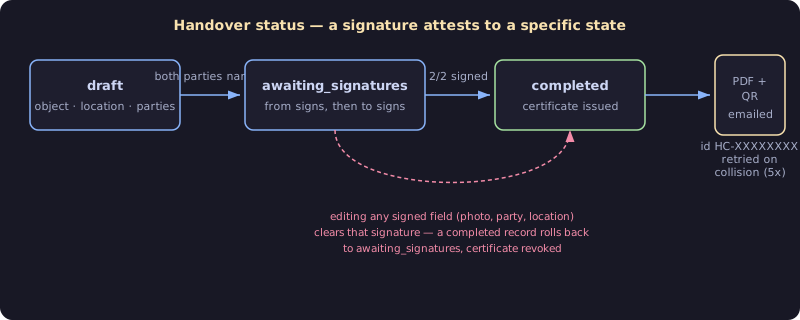
This is the one piece of business logic in the whole app that isn’t optional. Everything else is UX; this is what makes the word “certificate” honest.
The certificate ID itself (HC-XXXXXXXX, random hex) is generated and checked for a collision on insert, retried up to five times against a unique constraint at the database level — a bare loop is simpler and just as correct as pre-checking for existence, since the database is the actual source of truth for uniqueness either way.
Public by design, but not everything is public
The verification page — GET /certificates/:certificateId — is the one route in the app that’s intentionally open to anyone, no session required. That’s not an oversight; it’s the entire point. A certificate that only its creator can check isn’t a certificate, it’s a private note.
But “anyone with the link can verify this happened” is a narrower claim than “anyone with the link can see everything on it.” A stranger who finds a certificate link shouldn’t be able to read out someone’s ID number or download their signature image — they just need to be convinced the record is genuine. So a non-party viewer gets a name, a date, and a hash standing in for anything actually personal:
const isParty = !!req.user && (req.user.email === handover.from_email || req.user.email === handover.to_email);
const pdfUrl = isParty && handover.certificate_key ? storage.url(handover.certificate_key) : null;

let signatureHashes: Record<string, { hash: string; signedAt: Date }> | null = null;
if (!isParty) {
  signatureHashes = {};
  for (const sig of signatures) {
    const bytes = await storage.read(sig.storage_key);
    signatureHashes[sig.party] = { hash: hashPreview(bytes), signedAt: sig.signed_at };
  }
}
The hash is a truncated SHA-256 of the actual ID number or signature image bytes — deterministic, so the same underlying value always produces the same hash, but not reversible back into that value. That gets a non-party viewer something genuinely useful (if the record is later disputed, two people can compare hashes and confirm they’re looking at the same signature without either of them re-exposing it) without handing out the thing itself. The signed party still sees everything in the clear — isParty is the only branch, not a separate role — because ID numbers and signature images are exactly what they need the certificate to actually contain.
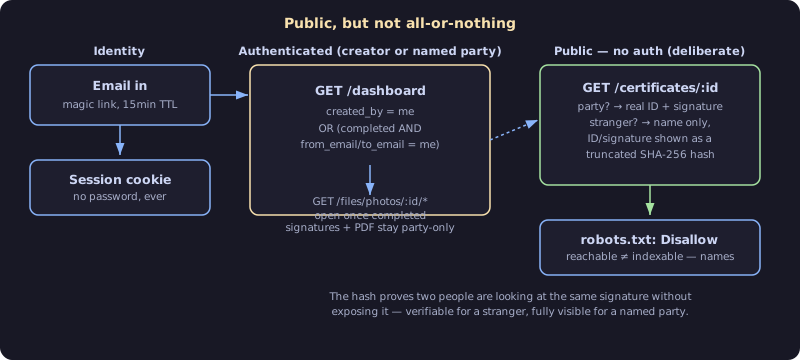
The file-serving route enforces the same split. Photos stay open on a completed handover, since they back the public page and were never the sensitive part; signatures and the PDF (which embeds both parties’ ID numbers and full signature images) are restricted to the creator-or-party audience even after completion, closing off the obvious workaround of just fetching the file directly instead of the hashed page:
const PARTY_ONLY_TYPES = new Set(["signatures", "documents"]);
// ...
const restrictedType = PARTY_ONLY_TYPES.has(req.params.type);
if ((handover.status !== "completed" || restrictedType) && (!req.user || !canView(handover, req.user))) {
  return res.status(404).end();
}
The certificate still carries real names, so the route stays out of the crawl entirely — “verifiable if you have the link” and “indexable” are still two different things:
Disallow: /dashboard
Disallow: /handovers
Disallow: /certificates
Disallow: /login
Everywhere else in the app, visibility follows one rule: you can see a handover if you created it, or if you’re named as a party by email once it’s completed. The dashboard listing encodes that same predicate independently, rather than trusting the file-serving route to be the only place it’s enforced:
WHERE created_by_user_id = $1
   OR (status = 'completed' AND (from_email = $2 OR to_email = $2))
A draft still in progress is never public, regardless of who asks — that part hasn’t changed; what changed is how much of a completed certificate a non-party actually gets to see.
Storage as an interface, not a decision
Uploaded photos, signature PNGs, and generated certificate PDFs currently live on the droplet’s disk, on a mounted volume so they survive a redeploy. But nothing in the route handlers knows that:
export interface Storage {
  save(key: string, data: Buffer, contentType: string): Promise<void>;
  read(key: string): Promise<Buffer>;
  url(key: string): string;
}
LocalDiskStorage is the only implementation today. The day this needs to move to S3 or R2 — for redundancy, or because a single droplet’s disk stops being enough — that’s a new class behind the same three methods, not a rewrite of every place a file gets touched.
Hosting: deliberately boring
There’s no  Kubernetes here, no managed queue, no serverless functions. Handovha runs as a single Node process under
  systemd, on one $6/month
  DigitalOcean droplet, behind
  nginx terminating TLS via
  certbot. Postgres runs on the same box. A deploy is
 npm run build, rsync the build output over, npm ci --production, restart the service, then poll /ready until it’s healthy.
That droplet runs more than one app — a second, unrelated tool shares it — and both are described in one YAML manifest that the setup and deploy scripts both read, rather than each app carrying its own bespoke infrastructure.
For the traffic this actually gets, that’s not a compromise; it’s the appropriately-sized amount of infrastructure. The interesting failure modes here are about data integrity — a signature meaning what it says it means — not about scaling a fleet of pods. Spending engineering effort on the latter before the former is solid would have been optimizing the wrong thing.
Practical Application
If you’re building something where two parties confirm a state and a third party might verify it later — a delivery, a return, a handoff of any kind:
- Don’t default to accounts. If the product’s entire pitch is “no app, no login,” a magic link that creates identity on first use covers what a password-based account would, with none of the friction.
- Scope a signature to exactly what it covers, and invalidate it on any change to those fields. A signature that can silently drift from what it originally attested to isn’t a signature — it’s decoration.
- Design public verification around “prove it happened,” not “expose the record.” A hash of the sensitive value often gives a stranger everything they legitimately need (tamper-evidence) without handing over the value itself.
- Size the infrastructure to the actual risk. If your hardest failure modes are data-integrity bugs rather than scale, a single small server is the right amount of infrastructure — don’t reach for more because it looks more serious.
Final Takeaway
A certificate is only as trustworthy as the guarantee behind the word “signed.” Handovha’s entire design is built around making that one guarantee unbreakable — a signature that can’t silently outlive the state it attested to, and a public page that proves authenticity without oversharing — while keeping everything else, from accounts to hosting, as simple as the problem actually allows.
If you want to see it:  handovha.com.